
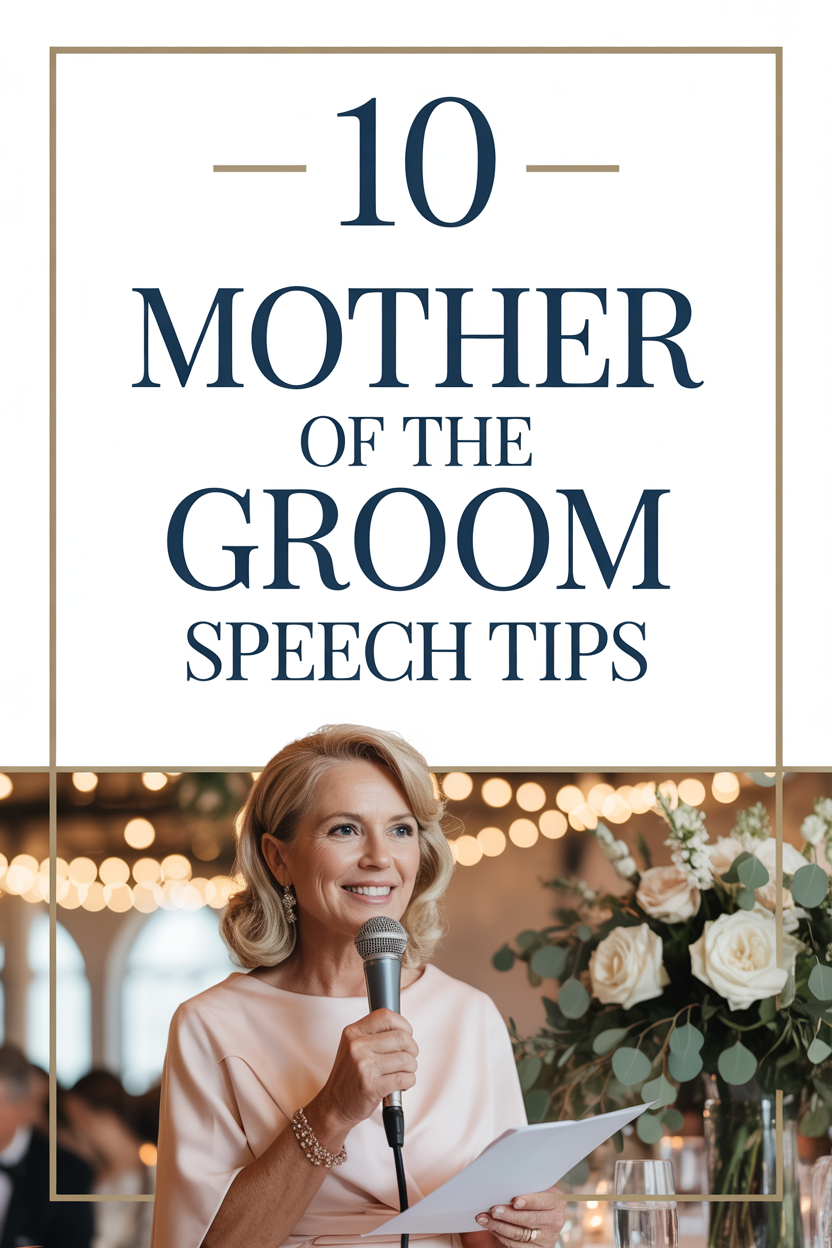

The mother of the groom speech is a tucked-in little jewel on the wedding day. It arrives after the toasts and before the dancing really takes off, and it holds this quiet superpower: your words can wrap the whole room in warmth, honor your son, and officially open the door to the newest member of your family.
You are not the main event, and that is exactly what makes it so beautiful. These ten tips will help you craft a speech that feels like you, lands with heart, and becomes a memory you will cherish long after the last champagne glass is cleared.
1. Open with a warm, inclusive welcome that sets the tone.
Your first few sentences are a verbal handshake with every guest. Thank them for traveling, for loving the couple, for showing up in their best shoes. This is also the moment to name the bride’s family with genuine affection, because a wedding is the meeting of two entire worlds.
You might say something like, “Good evening, everyone. I’m [Name], [Groom’s Name]’s mom, and I want to start by saying how wonderful it is to see so many faces that have meant so much to our family over the years. To [Bride’s Mother’s Name] and [Bride’s Father’s Name], thank you for raising the extraordinary woman who now holds my son’s heart.” That small gesture of acknowledgment costs you nothing and means everything.
2. Speak about your son the way only a mother can.
No one in that room knows the arc of his life quite like you do. The tiny, specific details are the ones that will catch the light: the way he insisted on wearing rain boots with shorts when he was four, the sound of his voice when he called home with big news, the quiet kindness he extends when no one is watching. You do not need to list every achievement; just choose one or two threads that reveal his character.
“From the very beginning, [Groom’s Name] has had a fierce sense of fairness… I remember him at eight years old dividing his Halloween candy so precisely that his little sister got exactly half, right down to the last gummy worm.” Those glimpses of his heart will mean more to him and to everyone listening than any resume-style recap.
3. Welcome your new daughter-in-law with intention and tenderness.
Many mothers of the groom speeches stumble right here because the emotion is so big it’s hard to package into words. Let it be big. Look at her, use her name, and say out loud what you have felt privately since you first saw the way she changed your son for the better.
“To [Bride’s Name], I don’t see you as someone I’m gaining… I see you as someone I am honored to know and love. Thank you for loving my son so completely, for bringing out the softest, strongest version of him, and for letting me be a small part of your world now too.” A phrase like that lands because it’s specific, it’s spoken directly to her, and it tells the whole room this is not a polite formality—it is a promise.
4. Choose one short, sweet memory that includes the couple.
You have a lifetime of solo memories of your son, but the wedding day is about the two of them. Pick a moment you witnessed when you realized they were building something real. It might be the first time you heard him laugh with full abandon around her, or a holiday where she matched your family’s traditions in a way that felt seamless, or just an ordinary Tuesday dinner when they didn’t notice you watching them move around the kitchen like a team.
“I knew [Bride’s Name] was family not at some grand moment, but on a rainy Sunday afternoon when she and [Groom’s Name] spent two hours teaching me to use a new phone, and neither of them acted like it was a chore.” A story like that is small enough to be true and big enough to make people smile.
5. Keep the whole thing comfortably short—aim for three to five minutes.
You are the closing act before the open dance floor, and a room full of people who have already wept through two speeches needs gentle pacing. Three to five minutes is the golden zone: enough time to land meaningful words, not so long that you lose the room’s collective attention. When you rehearse, time yourself.
If you find yourself creeping past six minutes, cut one anecdote or tighten a sentence. The best speech is the one where people lean in, not the one where they start glancing toward the bar. A crisp delivery leaves your son and his new spouse feeling celebrated, never held hostage by sentiment.
6. Mix the emotion with a little lightness and a lot of eye contact.
It is completely okay if your voice wobbles; that wobble is love made audible. What helps steady you is having moments of gentle lightness woven in—a small, affectionate joke at your own expense, a shared laugh about how your son used to practice his dance moves in the living room mirror, or a playful nod to the fact that you are now officially the second most important woman in his life (and you are thrilled about it). “I used to be the only one who could calm him down before a big test… turns out I’ve been beautifully replaced.”
As you deliver every line, let your eyes rest on the couple, then sweep the room, then come back to them. The eye contact grounds you and makes everyone feel included.
7. Mention your spouse or partner and the village that raised him.
Even if you are delivering the speech solo, it’s meaningful to name the people who helped shape the man standing at the altar. A sentence for your husband or wife, a nod to grandparents who are watching from a seat or from memory, a quick thank-you to siblings who shaped his character—these acknowledgments give your words a communal glow.
“I’d also like to thank my husband/wife [Name], who taught [Groom’s Name] that strength listens before it speaks, and to [Sibling Names], who made sure he grew up knowing how to share, how to fight fair, and how to love loudly.” This broadens the speech beyond you and makes it a family gift to the couple.
8. Practice out loud, but do not memorize every single word.
When you practice while driving, folding laundry, or walking the dog, you learn the natural rhythm of your sentences and discover which phrases feel too formal on your tongue. You want the structure memorized so well that you can find your place if emotion interrupts you, but you also want to leave enough breathing room that you can ad-lib a line that occurs to you in the moment. Record yourself on your phone and listen back; you will hear filler words you want to trim and catch the places where your voice naturally rises.
Then, on the day, carry a small note card with just bullet points—not the full script. Bullet points anchor you without shackling you.
9. Land the toast with a line that will ring in their ears for years.
The very end of your speech is what people will quote back to the couple on anniversaries. It does not need to be fancy. The strongest toasts are the simplest ones, spoken slowly, with your glass raised and your eyes on them.
“So let’s raise our glasses to [Groom’s Name] and [Bride’s Name]… may you always be as kind to each other as you are right now, may your home be full of laughter, and may every love story that comes from this family begin with the steady, beautiful example you two are setting.” Pause after the words, let the room catch up, and then take a sip. That small moment of stillness before the clinking glasses is pure gold.
10. After the speech, be fully present and let the words settle.
Once the microphone is handed back and the clapping subsides, give yourself permission to stop critiquing your delivery. Your job is done. The couple will remember the feeling of your words far more than any verbal stumble.
In the hours that follow, hug your son tightly, hold your new daughter-in-law by the hands, and notice the easy joy of the reception. The speech was a single beautiful chapter in a much longer story, and you wrote it with love. That alone is everything.
When you step up to the microphone, remember you are not performing.
You are a mother, speaking to her child and to the person he has chosen, surrounded by a room full of people who already adore you for showing up with an open heart. Trust your voice, lean into the imperfect tenderness of the moment, and know that the simplest words, spoken with honesty, become the ones that echo long after the music fades.