
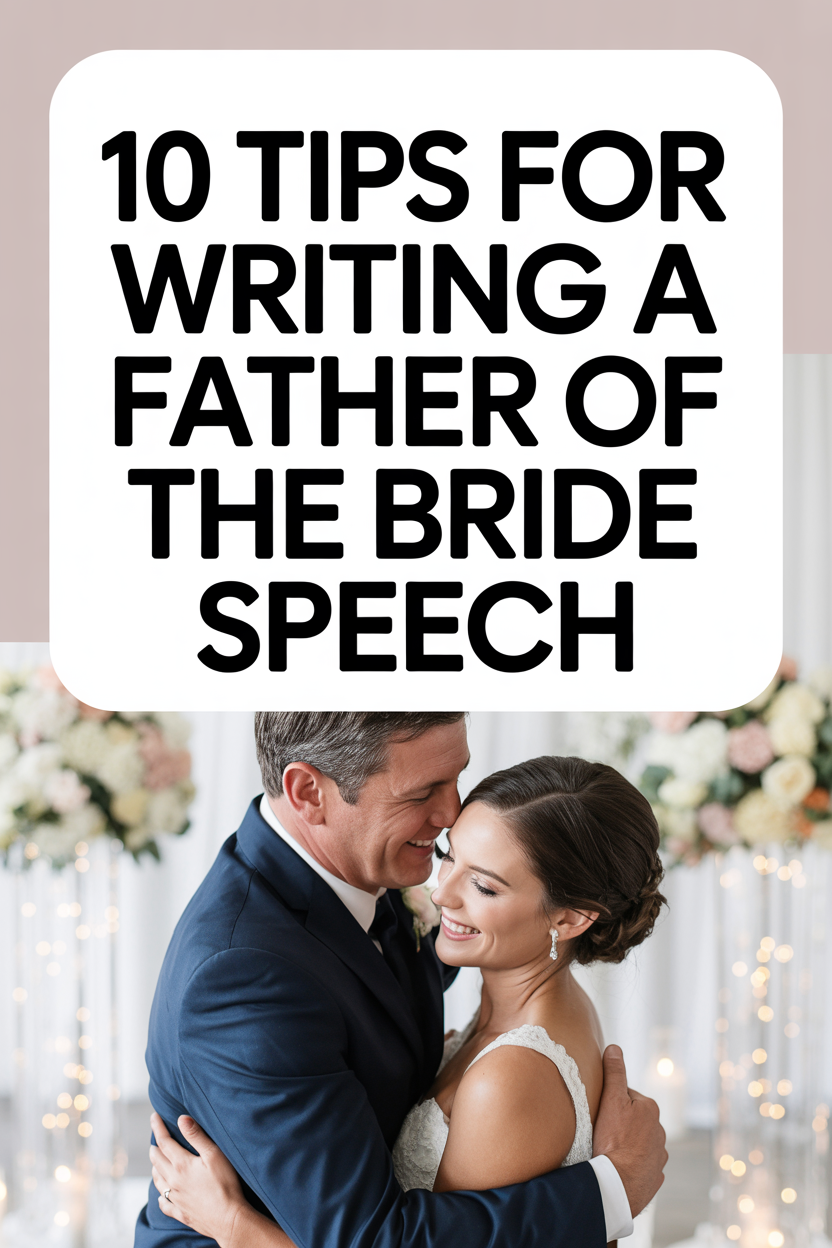

Standing up to give a father of the bride speech is one of those moments that lives somewhere between pure joy and total vulnerability. You are not just making a toast. You are ushering your daughter into a new chapter in front of everyone who matters most, and every word carries the weight of decades of love, memory, and quiet pride.
The good news is that the most unforgettable speeches do not come from polish or performance. They come from the heart, told with honesty and tenderness. This guide walks you through ten concrete ways to shape something that feels completely yours, from the first nervous scribble to the final lift of the glass.
Before you put a single word on paper: give yourself permission to be messy in the early drafts. You are not writing a presentation; you are collecting moments. Spend an afternoon with a notepad and just let memories surface.
A first day of school outfit she insisted on wearing for a week. A trip where everything went wrong and you laughed until your sides ached. The quiet conversation you had in the car when she was seventeen and needed to know she was enough.
These fragments are the raw material. Do not worry yet about structure or transitions. Just gather.
Another small but mighty piece of advice: write like you speak. Read your sentences out loud as you go.
If a phrase feels stiff in your mouth, it will feel stiff in the room. The goal is a natural, loving cadence, not a formal essay.
Contractions are welcome. A little laugh at your own expense is welcome.
So with those foundations in place, let us walk through the ten things that will turn your jumble of feelings into a speech that reaches right across the aisle and lands in her heart.
1. Start by welcoming everyone with genuine gratitude
Your very first words set the temperature of the room. After you introduce yourself (because not every guest knows you are the father of the bride), thank everyone for being there. Acknowledge the people who traveled long distances, the ones who helped with the planning, and the new family you are joining.
This is not just politeness. It is the moment you become the host of a shared feeling.
A simple opening might sound like this: “Good evening, everyone. For those of you I haven’t had the pleasure of meeting yet, I’m [Your Name], [Bride’s Name]’s dad. On behalf of my [wife/partner] and our whole family, thank you for being here tonight. Some of you crossed time zones, some of you crossed town, and all of you mean the world to us.” That small sweep of gratitude instantly softens the room and gives you steady ground to stand on.
2. Speak directly to your daughter’s partner and welcome them into the family
This is one of the most important transitions in the speech, and it deserves its own quiet focus. For months or years you have watched this person love your daughter, and now you get to say out loud what you have seen.
Keep it specific and true. Think about the first time you noticed how they looked at her, or the moment you realized your daughter had found someone who matched her in kindness, humor, or steadiness.
A short, honest passage works beautifully: “[Partner’s Name], I’ll never forget the day [Bride’s Name] told me about you. She had this little smile she tried to hide, and I thought, okay, this is different. Watching the two of you together since then has been nothing short of a privilege. The way you [specific small detail, like: listen when she talks about her day / make her laugh so hard she snorts / carry the heavy things without being asked] tells me everything I need to know. Welcome to our family. We are so much better with you in it.”
You do not need to overdo the fatherly approval or turn it into a performance. Just name the warmth you feel, and the rest speaks for itself.
3. Share one or two specific, tender stories about your daughter
The heart of the speech lives in story. Not a chronological biography, but a chosen vignette that captures who she is. Choose moments that reveal her character: her compassion, her stubborn joy, her quiet courage.
Keep each story short and paint it with sensory detail so the room can see it. For example: “When [Bride’s Name] was about [age], she insisted on [specific memory, like: building a fairy garden in the backyard using nothing but moss, pebbles, and an alarming amount of glitter]. She worked on it for days and wouldn’t let anyone help because, in her words, the fairies needed to know it came straight from her heart. That is who she has always been. Someone who pours her whole self into the things and people she loves. She hasn’t stopped building little worlds of kindness everywhere she goes.”
One or two of these stories will land deeper than a dozen rushed anecdotes. Let the room settle into the memory with you, then gently bring it back to the present and tie it to the woman standing beside you now.
4. Let a little gentle humor breathe without forcing it
A warm laugh in the middle of a heartfelt speech is a gift, but it works best when it rises naturally. Do not hunt for a punchline or recycle a joke you found online.
Instead, reach for the small, affectionate moments that come with decades of knowing someone. A dad-like observation, a cherished quirk, a fleeting glimpse of the little girl still living inside the grown woman.
Something tender and lightly funny at the same time. Try a line like: “I have to admit, I still see the little kid who used to [insert endearing habit, like: negotiate bedtime with the precision of a tiny lawyer / line up her stuffed animals for mandatory attendance at tea parties]. And honestly, she still gives me that same look when I suggest I know what I’m doing.”
The room will smile with you, and the laughter will feel like an exhale rather than a forced intermission. Follow the laugh with something grounded so the emotional momentum stays intact.
5. Tell the room what your daughter has taught you
This is where the speech shifts from celebration to quiet reverence, and it often becomes the part people remember long after the cake is gone. Speaking as a parent, you have a unique authority to name the ways your child changed you.
What did she teach you about patience, about wonder, about standing up for what is right? Frame it as a gift she gave you simply by being herself.
A few lines like these carry enormous weight: “Before [Bride’s Name] was born, I thought I understood love. Then I held her for the first time and realized I had barely scratched the surface. Over the years she has taught me to pay attention to the small things, to show up even when it is hard, and to let the people I care about know exactly how I feel. I am standing here tonight a better person because of her, and that is the truest thing I know.”
This is not an obligation to get choked up, though you might. It is permission to be honest about the impact of a life on your own. Let the emotion find its own level.
6. Acknowledge the people who helped shape her, especially your spouse or partner
A father of the bride speech is about your daughter, but it is also a chance to honor the constellation of people who raised her, supported her, and stood beside you along the way. If your spouse or partner is in the room, a few grounded words of recognition will mean the world. Avoid grand pronouncements and stick to simple gratitude.
Something like: “I want to take a moment to thank my [wife/husband/partner], [Name]. [He/She/They] has been [Bride’s Name]’s compass, confidante, and fiercest cheerleader. Watching the two of them together has been one of the great joys of my life. None of this happens without you, and I am so grateful we walked this beautiful, chaotic road together.”
You can also name a grandparent, a sibling, or a mentor who was pivotal. The key is specificity and humility. You are reminding everyone that love is a team effort, and that the bride arrived at this day carried by many hands.
7. Offer a short, sincere reflection on marriage and partnership
After a lifetime of love and, likely, a few hard seasons, you have earned the right to say something simple and true about what it means to build a life with another person. You do not need to give advice that sounds like a greeting card. A single honest observation can feel like a benediction.
Consider something like: “If I have learned anything in [number] years of marriage, it is that love is not the big dramatic moments, as wonderful as those are. Love is the thousand little decisions you make every day to show up for each other. It is picking up the phone when you are tired. Making the tea just the way they like it. Choosing kindness over being right. [Bride’s Name] and [Partner’s Name], you already have that goodness in you. I have seen it.”
Keep it brief, personal, and devoid of lectures. The most powerful thing you can do is to model humility, not certainty. Then raise your glass to their future, not to a set of instructions.
8. Use your daughter’s name often and speak directly to her in moments
There is something deeply intimate about hearing your own name spoken with love in a room full of people. As you write your remarks, occasionally turn the focus from the guests to the bride herself.
Look her in the eyes when you practice, and let the words be just for her. A direct address breaks the formality and makes the speech feel like a private conversation that everyone else is lucky to overhear.
For instance: “[Bride’s Name], I have loved you since before you took your first breath. Watching you grow into the woman you are today, standing here in that dress, with that steady joy in your eyes, I have never been prouder to be your dad. You have always had a way of making the world softer and brighter just by being in it, and I am so deeply happy that you found someone who sees all that light.”
You do not need to sustain the direct address for long. A few sentences nestled in the middle of the speech will feel like a bridge straight to her heart. After that, you can gently pull back to the broader room.
9. Keep it short and land the plane with a toast that feels complete
A father of the bride speech does not need to be a ten-minute epic. In fact, somewhere between four and six minutes is the sweet spot. That is long enough to say something meaningful and short enough to hold the attention of a room full of people who are also eyeing the dessert table.
As you write, trim anything that feels repetitive. Read the whole thing aloud and cut anywhere your own mind wanders. End with a clean, warm toast that gathers everyone.
Something like: “So please join me in raising your glasses. To [Bride’s Name] and [Partner’s Name] — may your life together be filled with endless laughter, quiet kindness on the hard days, and the kind of love that feels like coming home. To the bride and groom!”
That final line gives the room permission to erupt, and it lands with the satisfying click of a door closing gently. You have said enough. Now let the celebration continue.
10. Practice until the words feel like yours, then trust the moment
Even the most beautifully written speech can get tangled on the tongue if it has only lived on the page. Read it out loud several times in the days leading up to the wedding, not to memorize it word for word, but to absorb the rhythm so you can deliver it with presence rather than recitation.
Practice looking up. Practice pausing where the emotion rises.
If you worry about getting emotional, build in a breath or a small sip of water. On the day itself, keep the notes nearby but do not bury your face in them.
The room does not want perfection. They want you.
A little tremor in your voice, a genuine laugh that catches you off guard, a moment where you have to collect yourself — those are not mistakes. They are the proof that this matters.
And if you feel overwhelmed, simply look at your daughter. She will anchor you. You have been doing that for her whole life; now let her do it for you.
When you stand up to speak: remember that every person in that room is already on your side. They are not critiquing your grammar or measuring your delivery.
They are waiting to feel something real, and you have spent a lifetime preparing for this without even knowing it. All those bedtime stories, all those patient conversations in the kitchen, all the quiet ways you showed up.
A speech is simply an extension of that love, spoken aloud on one of the most beautiful days of your family’s life. Take a breath.
Look around the room. Speak from the fullness of your heart, and trust that the words you share will be exactly what the moment needs.